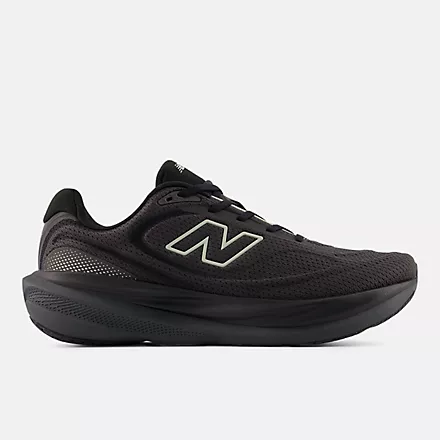
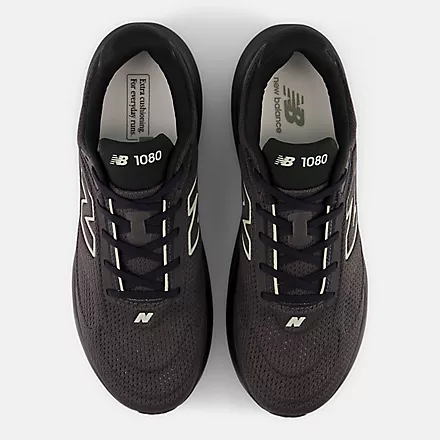
We had 20,000 feet virtually try on the 1080 v15. New Balance's size chart gave the right size for 58% of them, so we'd call the chart fine for most feet but a gamble for narrower ones. The shoe itself is a soft, bouncy daily trainer with a roomy upper and a well-cushioned heel.
Does the 1080 v15 run true to size?
Size guide accuracy score
58/100
The brand's own size guidance gives the right size for about 58% of 20,000 feet.
Most of the misses go one way: 27% of feet needed to size down a full size or more, while 15% needed to size up. The 1080 v15 has a lot of room inside, so slimmer feet often end up with more shoe than they need at the chart's size.
Which part of the 1080 v15 gives feet the most trouble?
How a foot sits in a shoe: the ball of the foot settles where the shoe bends most easily, called the flex point, and the girth around the ball of the foot holds the foot in place. If the shoe is longer than the foot, the extra length ends up in front of the toes or behind the heel, depending on how far the ball of the foot sits from the heel, called the arch length.
Toe room
12%have crammed toesGirth around the foot
19%feel tight on the sidesHeel
31%have heel slipAt the size the brand's chart gives. The zone with the most trouble is highlighted.
Heel slip is the most common trouble, at 31% of feet. Toe room is rarely a problem: only 12% had crammed toes, and 19% felt tight on the sides.
Who is the 1080 v15 good for?
How often the brand's own sizing guidance is accurate for each foot length.
Shorter feet
54%under 257 mmMedium length feet
63%257 to 293 mmLonger feet
52%over 293 mmHow often the brand's own sizing guidance is accurate for each foot type.
Narrower feet
41%Average feet
66%Wider feet
71%The highest result in each chart is marked in green.
The fit at its best
Wider feet do best in the 1080 v15. The chart gave the right size for 71% of wider feet, the highest of any group, and average feet were close behind at 66%.
Who will love the 1080 v15
Runners with average to wider feet who want a soft, bouncy shoe for easy days and long runs. If that sounds like you, the fitting will show whether the 1080 v15 is one of your top matches, and how each size will feel.
How the shoe is built
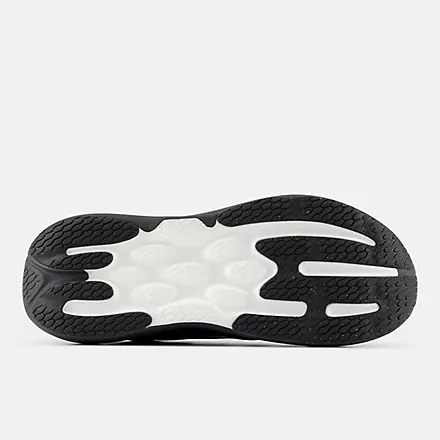
The midsole is Infinion, New Balance's new nitrogen-infused foam, which replaces the Fresh Foam X of earlier versions. The foam sits about 40 mm thick under the heel and 34 mm under the forefoot, for a 6 mm drop. The upper is a soft mesh with a gusseted tongue, meaning the tongue is attached to the sides of the shoe so it stays in place. The heel counter (the stiff cup around the heel) is firm, with padding at the top of the collar. The outsole uses firmer rubber at the heel and softer rubber toward the front, with foam left uncovered in the middle.
What about your feet?
The numbers above describe 20,000 other feet. Your feet have their own length, width and girth, and only a scan can show which group you belong to. MatchUp's free shoe fitting scans your feet with your phone and a sheet of paper and asks how you run and what you like in a shoe. Then you can see how the 1080 v15 fits you, which other shoes suit you, and how each size of each shoe will feel, so you choose the size you want.
 Get fitted
Free, nothing to install.
How we measured
We took 20,000 foot scans from MatchUp's earlier in-store 3D foot scanners and had every foot virtually try on the 1080 v15. For each foot, we compared the size New Balance's chart gives with the size MatchUp picks from the foot's length, girth, and arch length. A difference of a full size or more counts as a miss. These numbers show how the shoe fits a big group of feet, not how it feels on a run, and your feet may be different.