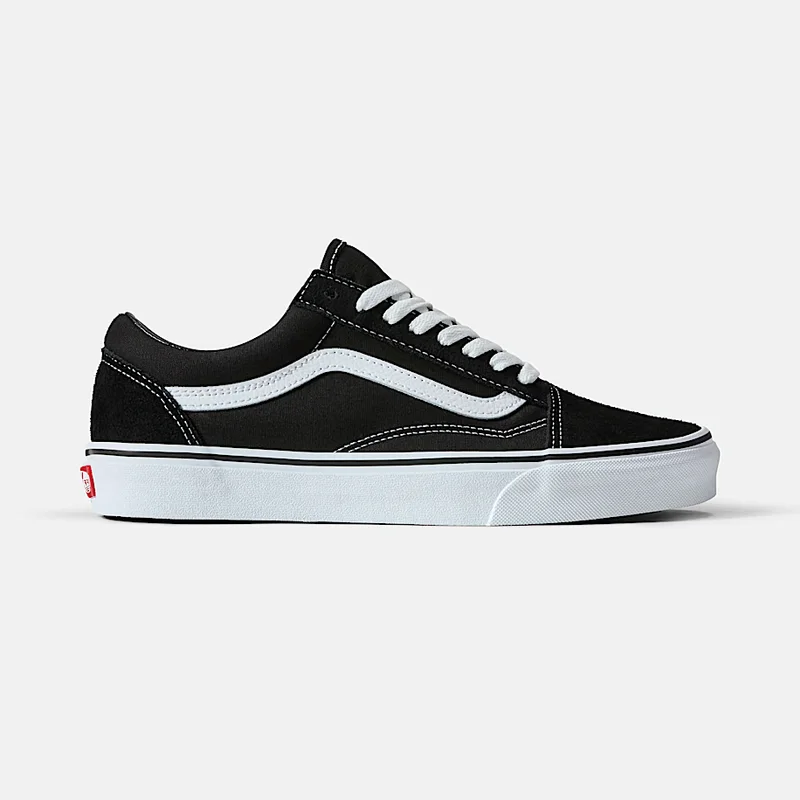
Does the Vans Old Skool run true to size? Should you size up?
We checked, on 9,994 real feet. We worked out the inside measurements of the Vans Old Skool in the standard width: the length, the width, and the forefoot volume (ball girth). Then we virtually fitted 9,994 real feet from our earlier in-store 3D foot scanners, the way someone shopping online would: Vans's size chart for length.
Vans size guide score
67/100
Vans's size guidance online gave the right size for 67% of 9,994 feet.
Does the Vans Old Skool run true to size?
Yes, for about 2 in 3 feet. If you follow Vans's size guidance online, the Old Skool fits true to size for 67% of feet. Here, true to size means the size Vans's online guidance gives you is less than a full size away from the size that fits best, with enough toe room and enough forefoot volume.
Vans's size chart is clear: the chart lists the foot length for every size in both inches and centimeters, with men's and women's sizes side by side, and reminds shoppers that the longest toe isn't always the big toe. The guidance falls short on forefoot volume. Vans makes a wide version of the Old Skool and states that the wide version has a ball girth 10 mm bigger than the regular width, but Vans's size guidance online gives shoppers no way to find out whether they need the wide version, so our score uses only the standard width. If Vans's guidance showed shoppers how to pick between standard and wide, the score would have been 79.
Should you size up or down in the Vans Old Skool?
The Vans Old Skool and the Vans Authentic have a very similar overall silhouette and size the same way, so both came out the same in our fittings. Here is where every foot landed in the Old Skool, in the standard width, when we followed Vans's size chart.
Following Vans's size guidance online
- Right size from the size chart67%
- Sized up for more forefoot volume23%
- Sized up for toe room only8%
- Sized down for less forefoot volume2%
Share of 9,994 feet. Each foot is counted once.
- Right size from the size chart: 67% of feet got a size that fit both their foot length and their forefoot volume in the standard width. Vans's size chart worked well for this group in the Old Skool.
- Sized up for more forefoot volume: For 23% of feet, the standard width had too little forefoot volume at the size the chart gave. In the standard width, going up a size was the only way to get more forefoot volume, and the bigger size also adds length in front of the toes. The wide version adds forefoot volume and keeps the length, if you already know you need a wide width.
- Sized up for toe room only: 8% of feet had enough forefoot volume, but the length the chart gave left their toes very little room. If your foot is near the long end of your size on Vans's chart, consider half a size up in the Old Skool.
- Sized down for less forefoot volume: For 2% of feet, the standard width had too much forefoot volume at the size the chart gave. The Old Skool has no narrow version, so a smaller size was the only way to get less forefoot volume, with less room in front of the toes.
How we measured
We measured the standard width of the Old Skool and virtually fitted 9,994 real feet from our earlier in-store 3D foot scanners. Out of 17,311 foot scans, those 9,994 feet fall in the sizes we tested (US men's 6.5 to 16). For every foot, we followed Vans's size guidance online: the length chart, in the standard width. The score of 79 with the width options is estimated from standard width steps, not measured on the wide version itself. A difference of a full size or more between Vans's size and the size that fits best counts as a miss. These numbers show how the Old Skool fits a large group of feet, not how the shoe feels on your feet.